The Centre provides knowledge services and capacity development assistance. Services include analytical and advisory services, learning and skill development, know-how and knowledge transfer, and technical assistance and institutional strengthening. All CFRR publications are available on this site.

Audit Oversight to Enhance Trust and Transparency in Corporate Financial Statements: Challenges in Developing Countries
Publication | 2019
Beginning with the Sarbanes-Oxley Act in the United States and the creation of the Public Company Accounting Oversight Board (PCAOB) in 2003, a global movement has developed to require independent oversight of corporate auditors. The movement is premised on the notion that independent oversight of auditors is critical for investor confidence, stronger corporate governance, and more financial transparency. A signal event in this movement was the EU’s Statutory Audit Directive of 2006, which required independent oversight to be developed in all EU member countries. Similar s
Focus Areas

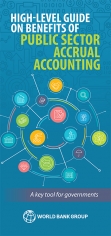
High-Level Guide on Benefits of Accrual Accounting
Brochure | 2019
A high-level guide on the benefits of accruals based Public Sector Accounting developed under the PULSAR program. The guide serves as an instrument to support clients in their outreach and dialogue to raise awareness of the advantages of accrual accounting adoption.
Focus Areas


Benchmarking Guide: Integrated PSA and GFS
Publication | 2019
The Benchmarking Guide for Integrating Public Sector Accounting and Government Finance Statistics aims to inform practitioners and public sector accounting reforms by highlighting the similarities and differences between International Public Sector Accounting Standards and Government Finance Statistics reporting guidelines such as the Government Finance Statistics Manual of the International Monetary Fund (GFSM 2014) and the European System of Accounts (ESA 2010).
Focus Areas
Competency-based Accounting Education, Training & Certification: Implementation Guide
Publication | 2019
The guide supports transitioning accounting education, training, and certification from a knowledge-based approach to a competency-based approach. Underlying this shift is the expanding expectation for accountants to professional judgment in response to greater transaction complexity, interconnectedness of entities, and broader global influences.
Focus Areas


Linking financial reporting quality and cost of debt: Evidence from Serbian SMEs
Publication | 2017
This publication is an empirical study on financial information and cost of finance in Serbia. Using the financial statement database of the Serbian Business Registers Agency (APR), we analyze the extent to which the quality of a company’s financial reporting is associated with its cost of debt. The focus of this study is small and medium enterprises (SMEs) because they represent a critical segment of the economy in most countries.
Focus Areas


A4G Preliminary Landscape Assessment for Western Balkans
Publication | 2019
It is the first report prepared under the Accountants as Catalysts for Growth (A4G) initiative. EU-REPARIS has been designed to help and encourage the process of aligning legal frameworks in accounting and audit with the EU’s Acquis Communautaire and encourages the accounting profession to offer enterprises, especially MSMEs, effective business support services and advice on accessing finance and complying with regulatory requirements.
Focus Areas

Enhancing Cooperation between Auditors and Supervisors: A Building Block Approach
Publication | 2019
Building trust takes time, whether it is between individuals, stakeholders’ groups, or institutions, the road to cooperation is long and requires important investments. The objective of this policy note is to provide in a succinct document, some of the key aspects for building that trust to foster cooperation, using the experience of several supervisors.
Focus Areas


Be Well Prepared to Meet Your Bank - What Banks want to know
Brochure | 2019
The bank will want a realistic picture of how much you owe to others. This is not always straightforward.
Focus Areas

Do You Need a Loan - Helping SME Access Finance in Serbia
Brochure | 2019
This brochure aims at helping SMEs access credit in Serbia, by providing 8 insights to help SMES how banks make lending decisions.
Focus Areas

How to Choose Your Accountant
Brochure | 2019
Banks need reliable, transparent financial information when making credit decisions. A financial advisor or accountant can advise you on when it could be advantageous to seek out a bank, and help you calculate, compile, and present your information to banks.
This brochure will help you in choosing a financial advisor or accountant for your SME.
Focus Areas